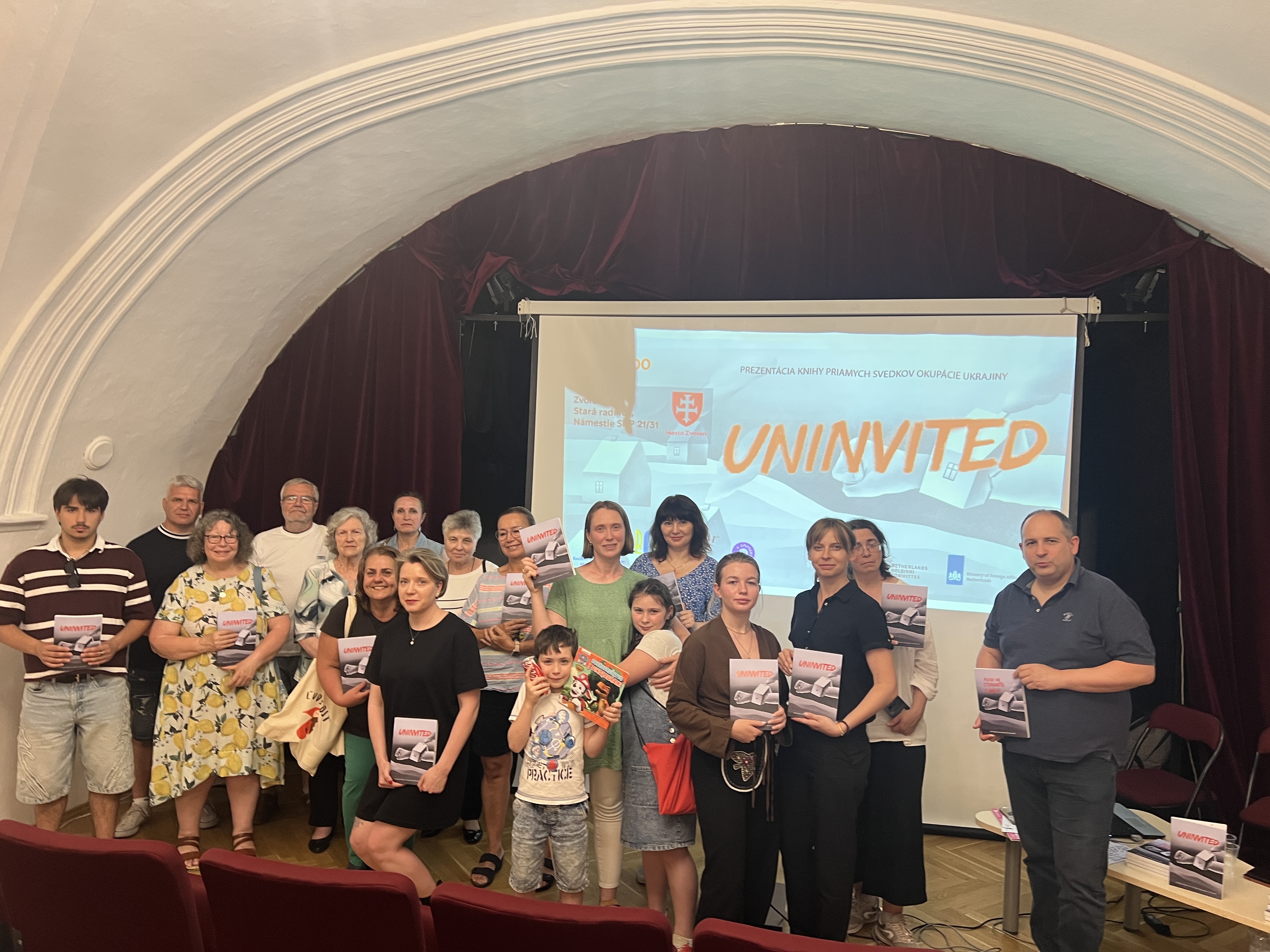
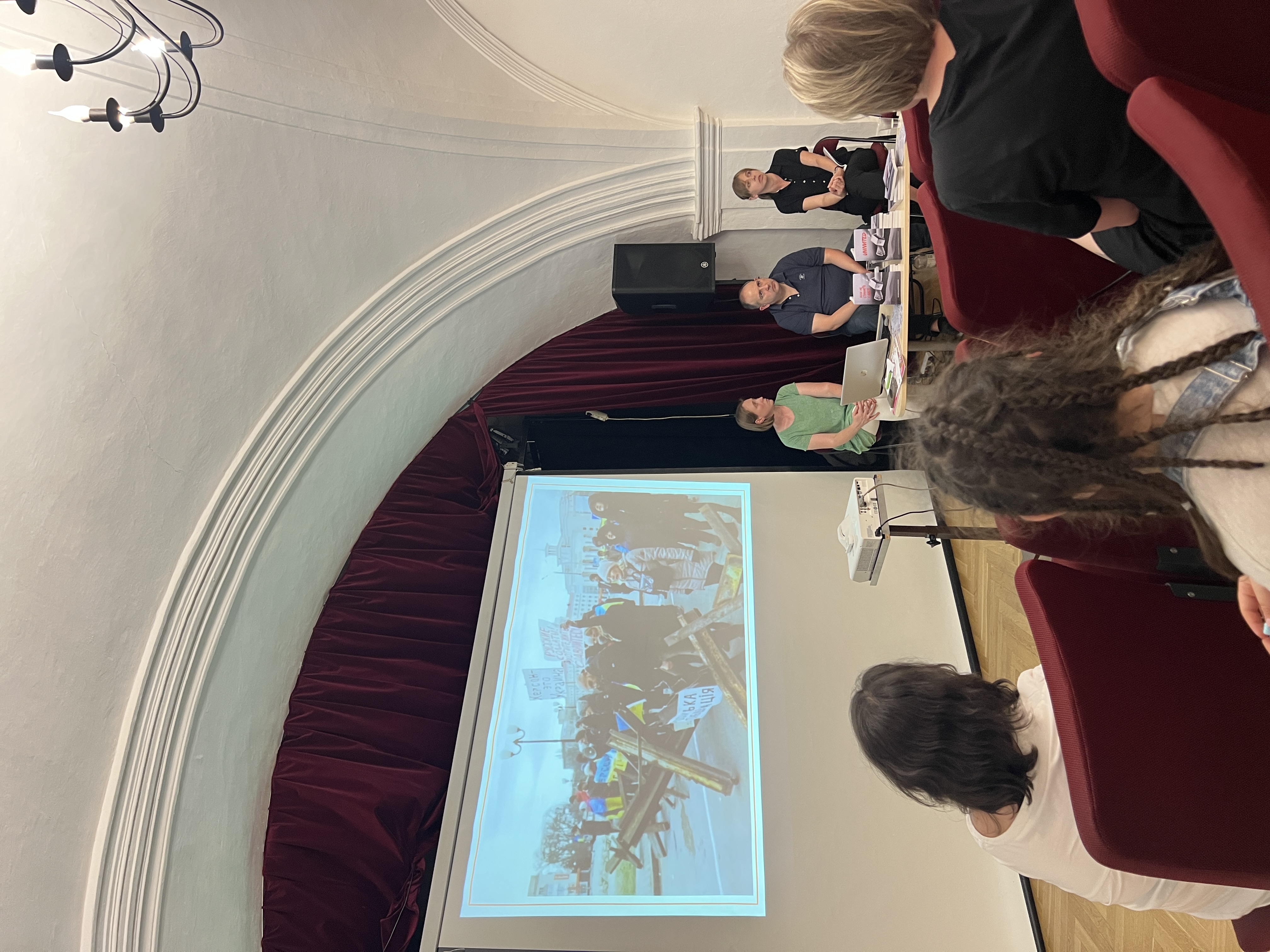
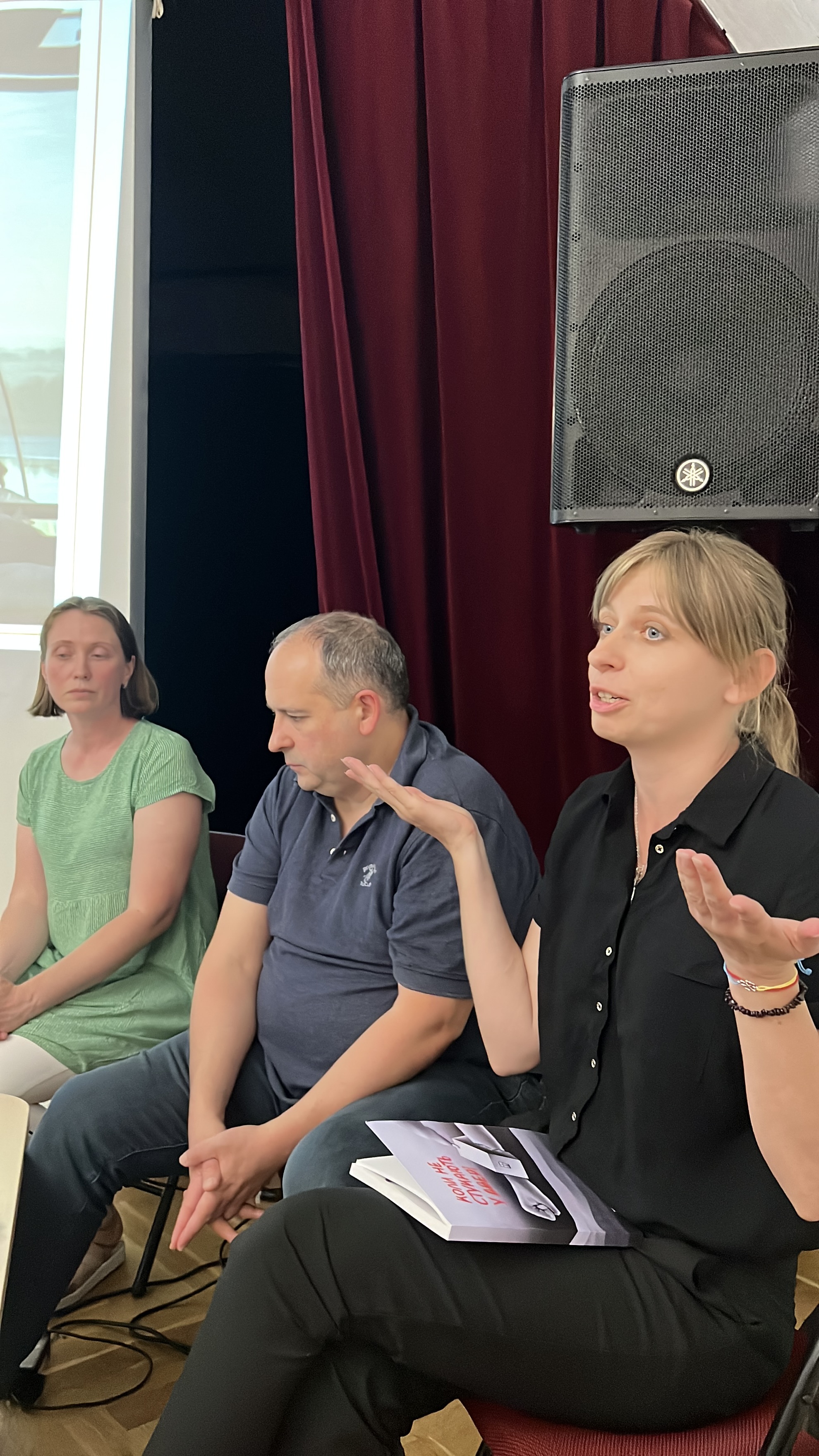
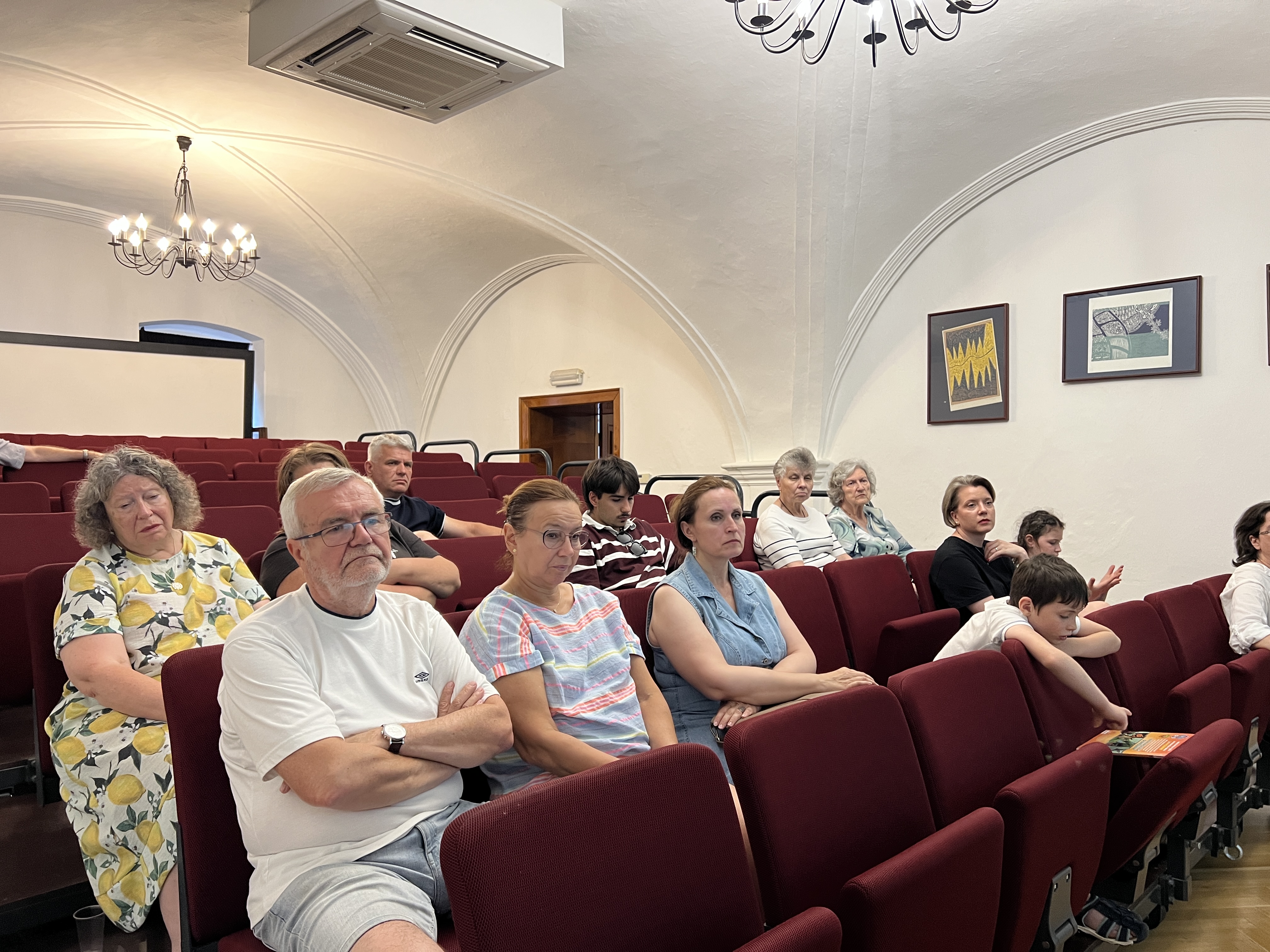
On July 3, the presentation of the book “Uninvited: 25 Stories About the Russian Occupation” took place in the Old Town Hall of the Slovak city of Zvolen. The event was organized by the East Ukrainian Center of Civil Initiatives (EUCCI) in cooperation with local organizations Ukrajinské centrum, Ľudskosť, and Človek v orozneňí. The presentation was attended by Mr. Volodymyr Shcherbachenko, the book’s editor and head of the EUCCI, Maryna Suprun and Anastasiya Kozak, co-authors of the publication, as well as representatives of the Ukrainian community and residents of Slovakia.
Opening the meeting, Volodymyr Shcherbachenko thanked the Slovak partners for their help in organizing the event and emphasized that the book was created primarily for an international audience, in order to explain to Europeans what life under Russian occupation really means.
Maryna Suprun said that the East Ukrainian Center of Civil Initiatives has been documenting Russian war crimes since 2014 — illegal detentions, torture, sexual violence, and other gross human rights violations. According to her, after the start of the full-scale invasion, it became obvious that the world needed not only legal evidence of crimes, but also human stories that would help understand the price of occupation. This is how the idea for the book “Uninvited” was born and later implemented with the support of the German organization KURVE Wustrow.
A peculiarity of the presentation in Zvolen was an open and sometimes heated discussion with the Slovak audience. Volodymyr Shcherbachenko invited those present to recall how they perceived the events of 2014 in Ukraine and what they remember from the media reports of the time. One of the attendees repeated the widespread pro-Russian narrative about the alleged involvement of “Georgian snipers” in the shootings on Maidan. Ukrainian participants in the meeting noted that this was the first time they had heard such an interpretation, and cited facts about the Russian annexation of Crimea, the participation of Russian military personnel in the seizure of Ukrainian territories, and the systematic disinformation that accompanied the aggression from the very beginning. Despite the arguments presented, the man didn’t change his opinion and later left the event. This episode clearly demonstrated how strong beliefs formed by Russian propaganda can be and why direct dialogue with a European audience remains an important part of countering disinformation.
Telling his own story, Volodymyr Shcherbachenko took the audience back to Luhansk in 2014. He recalled how peaceful public initiatives gradually came under pressure from pro-Russian forces, how activists began to be threatened, and the streets were filled with organized groups controlled from Russia. According to him, few could have imagined then that the information campaign, propaganda, and street violence would escalate into a full-scale war.
“You’ve got to safeguard peace, because there are states that seek to destroy it. War can come to your home in different ways,” he said, emphasizing that Russian aggression begins long before the first shots are fired.
The story of Anastasia Kozak from Kherson was no less emotional. She recalled how she worked in the regional scientific library, the building of which was later destroyed by Russian shelling, and how the occupation changed the ordinary life of the city.
“The Russians helped me learn what empty store shelves are like, multi-day queues for bread, and the fear of turning on the light in my own apartment.”
According to the author, during the occupation, she continued to maintain the library’s pages on social networks, supporting the residents of Kherson and reminding them that the city remains Ukrainian.
“The occupation is very scary. I want you to know about it only from such books and never experience it in your city,” she emphasized.
After the presentation, the participants and the authors went on talking for a while. One of the Slovak participants of the meeting noted that the book provides an opportunity to see the war through the eyes of people who experienced it, and called such testimonies important for the whole of Europe.
“These are the stories of real people who survived the terrible years of occupation. Such a book should be read by as many people as possible throughout Europe,” she said.
The book presentation was made possible thanks to support by the Netherlands Helsinki Committee and the Netherlands Ministry of Foreign Affairs.
